
The clinical literature on male hair loss products is larger and more rigorous than most people realize — but it's also uneven. Some approaches have decades of well-controlled trial data. Others have promising smaller studies. And many widely-sold products have essentially no independent evidence at all. Here's how to read the landscape.
The Gold Standard: Randomized Controlled Trials
The most credible evidence comes from randomized, double-blind, placebo-controlled trials (RCTs). These remove researcher and participant bias by comparing active treatment against an identical-looking placebo, with neither party knowing who receives what. Outcome measures in hair loss trials typically include standardized hair counts per cm², hair diameter measurements, and validated patient-reported scales.
For male hair loss products specifically — including those reviewed in our product types guide — outcome measurement is standardized: hair loss trials use phototrichogram or TrichoScan analysis to provide objective data. Global photographic assessment by blinded dermatologist panels is also common. These methods are reproducible and minimize subjective bias.
Minoxidil: The Established Baseline
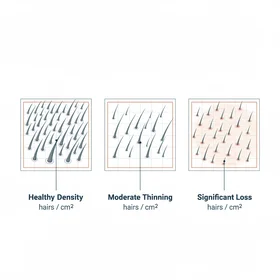
Topical minoxidil has been studied since the 1980s and has the largest body of clinical evidence of any OTC hair loss treatment. A landmark multi-site trial published in the Journal of the American Academy of Dermatology showed that 5% minoxidil produced significantly greater hair regrowth than 2% and placebo in men with vertex hair loss over 48 weeks. Subsequent meta-analyses have consistently confirmed efficacy for crown/vertex thinning in men with androgenetic alopecia.
Key finding from the research: minoxidil works best in the early-to-mid stages of loss on the crown. Evidence for frontal hairline recovery is weaker. Starting earlier in the loss progression consistently produces better outcomes.
Finasteride: Highest Efficacy Among Oral Options
Finasteride (1mg/day) is supported by multiple Phase II and Phase III trials. The pivotal studies enrolled over 1,500 men and showed that 83% of finasteride users maintained or increased their hair count over two years, versus 28% of placebo recipients. Studies at five years showed continued benefit with ongoing use.
The mechanism is well-characterized: finasteride inhibits Type 2 5-alpha-reductase, reducing scalp DHT by approximately 60%. This directly addresses the primary driver of male pattern baldness in genetically susceptible men.
Natural DHT Blocking Compounds
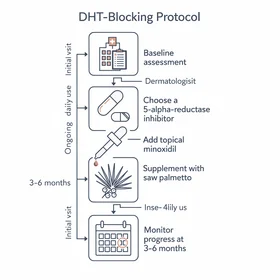
Several natural compounds have been studied for DHT-blocking activity:
- Saw palmetto (Serenoa repens): Multiple studies suggest mild inhibition of both Type 1 and Type 2 5-alpha-reductase. A 2002 study in the Journal of Alternative and Complementary Medicine showed statistically significant improvement in 60% of participants. A 2012 comparison with finasteride found saw palmetto less effective but better tolerated.
- Beta-sitosterol: A plant sterol found in saw palmetto and many other plants. Shows DHT-blocking activity in vitro and some supportive clinical data.
- Pumpkin seed oil: A 2014 RCT published in Evidence-Based Complementary and Alternative Medicine showed a 40% increase in hair count in men taking 400mg/day over 24 weeks, versus no change in placebo group. Small study (n=76) but well-designed.
- Green tea extract (EGCG): Inhibits 5-alpha-reductase in vitro and has shown some supportive effects in combination products.
Combination Products and IRB Studies
Some supplement manufacturers have sought IRB (Institutional Review Board) approval for their clinical protocols — a meaningful step that subjects the study design to independent ethical and methodological review. Products backed by IRB-approved studies have undergone more rigorous evaluation than those relying solely on general ingredient research.
Procerin, a dual-component system (oral supplement + topical activator) targeting the DHT pathway, has been evaluated in an IRB-approved clinical study. This is a meaningful distinction from the majority of OTC supplement products, which cite ingredient-level studies rather than product-level evidence.
What the Research Tells Us About Timing
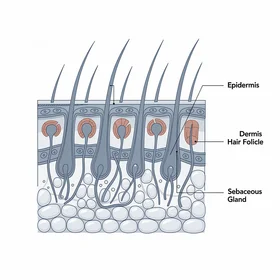
Across all product categories, one finding is consistent: earlier intervention produces better outcomes. Follicles that have undergone severe miniaturization are generally non-rescuable. Products that slow or halt the process while follicles still have function can preserve hair that would otherwise be lost. Reversal of advanced loss is rare with any non-surgical approach.
What to Look For in Evaluating a Product
Before spending money on a male hair loss product, ask:
- Is there a randomized controlled trial, or just observational data?
- Was the study conducted on the actual product, or on an isolated ingredient?
- What was the comparison condition — placebo, or nothing?
- What outcome was measured — hair count, diameter, patient rating?
- Has the study been published in a peer-reviewed journal or independently reviewed?
Products with IRB-approved studies, peer-reviewed publications, or both are worth more scrutiny — and more confidence — than those relying solely on testimonials or proprietary claims. For a detailed independent review of Procerin's IRB clinical study data and how it compares to competitors, see Procerin Review.